FIVE Fridays are typically for paid subscribers, but I wanted to share our New Year’s Edition with all of you. Here’s to an adventure-filled, whole-hearted 2026, I’m so excited to kick it off with you!
Happy FIVE Friday and Happy New Year!
This week I was in the Canadian Rockies, where I took my 13-year-old son snowshoeing and fat tire e-biking for the first time. Living in Los Angeles is great, but there is something magical about being in the expansive mountains of the white north that puts health and wellness into clear focus. Fitness feels fun. I haven’t even thought about the gym. Despite sub-zero temperatures, Jack and I have been playing outdoors every day, and I came up with some bodyweight routines to do in the hotel room for strength training and mobility.
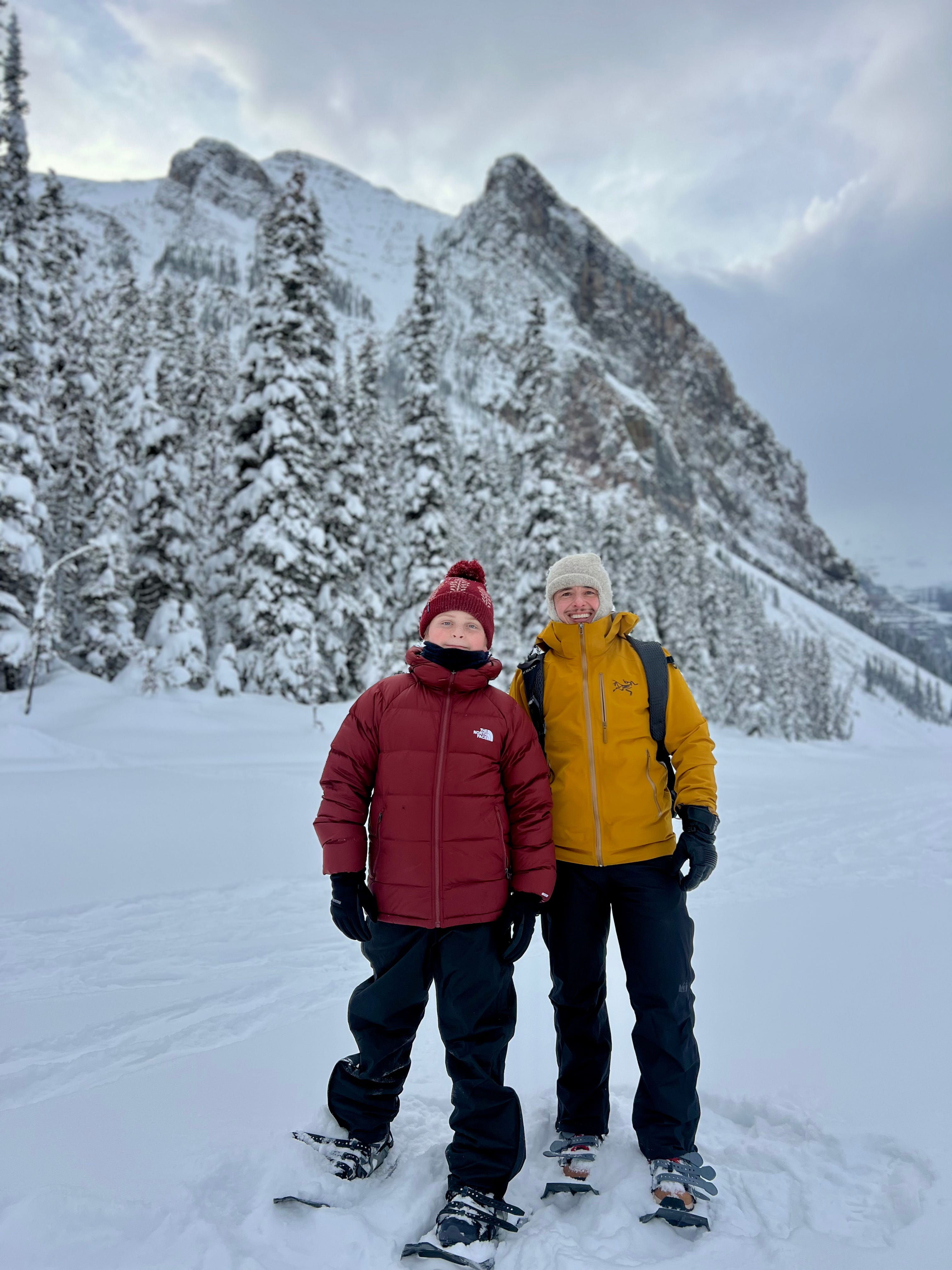
It’s become apparent to me that my favorite way to stay fit at 45 is to be active outside, supplemented by strength challenges that counteract sarcopenia. I’ve done the research and want to share some findings with you on what could mean for your own fitness journey.
In today’s post…
🏃♀️ Movement: Building functional movement from the ground up.
🏋️ Strength: A “Simple and Sinister” program.
🥗 Nutrition: Am I a snake? The case for 2 meals a day.
🛌 Recovery: The couch is not your friend.
🧠 Mindset: Just show up and have fun.
🏃♀️ Building functional movement from the ground up
Whenever I’m playing in the mountains, I always think about how I can incorporate the same rugged, functional movement into my training at home. For example, I started incorporating rugged movement into my training in 2025 with rucking (weighted walking). So far, my functional movements have all been from the gym: pushing, pulling, hinging, carrying, and squatting weights. But, what if there was a way to practice functional movement at home, as well as fix some nagging mobility problems with my wrists and knees?
That’s why, my friends, I’ve found myself currently obsessed with the idea of “ground-based” aka “primal” aka “animal” movement. Experts in these movement patterns appear graceful and light, but they are also strong, mobile, and flexible. The four basic movements shown in the video below are:
Bear
Monkey
Frogger
Crab
You can put them together to create flows and intensify the movements by changing your body position. My hypothesis is that by combining ground-based movement work with strength training, my body will develop a level of resiliency and mobility that I haven’t felt in years.
This week: I’ll be practicing ground-based movement throughout January, and I’d love for you to join me. Watch the video, practice the moves, and send me a message letting me know what you think.
🏋️ A ‘Simple and Sinister’ program
NOTE: Throughout January, this section will showcase strength training programs that are (1) highly effective, (2) highly efficient, and (3) approved for beginners.
When I was in my late 30s, I tore my bicep using a kettlebell. Kettlebells initially drew my attention because they are simple, effective, and a low-cost way to build muscle and stamina. I still think kettlebells are all these things.
The mistake I made was that I followed a 20-something social media influencer who encouraged getting “swole” by doing heavy flows. Flows (multiple exercises done in a rapid sequence) are not a great idea for beginners, and are really just Instagram theater. Before getting into flows, it’s essential to master basic movements with safe starting weights.
The “Simple and Sinister” (S&S) kettlebell plan by Pavel Tsatsouline is one of the best programs for mastering basic movements—there’s only 2! Despite being minimalistic, it certainly isn’t easy. The goal of S&S is to build strength, power, endurance, and resilience with simple exercises, in a short amount of time.
5-6 days per week, perform:
Warmup
Do 3 sets of 5 reps for each: Prying Goblet Squat, Hip Bridge, Halo.
100 kettlebell swings
Do 100 kettlebell swings in sets of 10 within 5 minutes (taking quick breaks between sets). They can two-hand (beginner) or one-hand (intermediate). Ladies, start with 12 kg (26 lb) and men, start with 16 kg (35 lb).


Rest
1 minute.
10 kettlebell / turkish getups
Do 5 getups each arm within 10 minutes. Ladies, start with 8 kg (18 lb) and men, start with 12 kg (26 lb).

IMPORTANT: If these weights feel potentially catastrophic, use something lighter to start. The goal for the “Simple” version of S&S is to increase your weight gradually (without injury!) until you can do 24 kg swings and 16 kg getups (ladies) or 32 kg swings and 32 kg getups (men).
For Pavel’s complete guide to S&S, including the Sinister portion, you can find his book online. Or, shoot me a message for 1:1 coaching.
This week: If you’re feeling bullish on building functional strength with kettlebells and are hard-pressed for workout time, give Pavel’s S&S plan a try. If not, I’ll have a new program for you next Friday.
🥗 Am I a snake? The case for 2 meals a day
People have made comments about the way I eat my entire life. That I don’t eat enough. Or that I don’t eat the right thing at the right time. Asking if I have food issues. I think what people find bizarre is that I don’t subscribe to the “3 meals a day” plan and I don’t eat when I’m not hungry, even if it’s perceived as being antisocial. My son even asked me this week “are you a snake or something?” when I passed on breakfast because I was still satiated from the previous night’s dinner.

It turns out, there is a biological reason for that. I recently came across Two Meals a Day by Mark Sisson, who explains that our bodies aren’t designed for constant grazing. I’ve been following Mark for years, first reading his blog “Mark’s Daily Apple” and then his book Primal Blueprint. I respect his opinions and his research. Mark says that for people aged 40–60, eating by the clock keeps insulin high, which “locks” our fat stores and prevents us from using them for fuel.
Mark’s approach is about regaining metabolic flexibility, the ability to switch between burning sugar and burning stored fat. The blueprint is simple:
Trust your gut: Move away from rigid meal times and eat for satiety, not the clock
Clean the fuel: Prioritize protein and plants while cutting refined sugars, grains, and seed oils
Balance movement: Support your metabolism with walking and strength work rather than just exhausting cardio
Skipping a meal isn’t about restriction; it’s about performance and listening to what your body actually needs.
This week: Audit your hunger before you pick up a fork. Try eliminating snacks between meals and only eat when you feel a genuine physical need for fuel, even if that means passing on a traditional mealtime because you’re still satisfied from the night before.
🛌 The couch is not your friend
If you want to bounce back faster after exercise, research shows that light movement beats complete inactivity every time.
It’s a common misconception that active recovery is just about “clearing lactic acid,” but it’s also about blood flow and lymphatic drainage. Your lymphatic system (the body’s waste removal service) doesn’t have its own pump. It relies on your muscles moving to flush out toxins. A simple walk can increase this clearance rate by up to six times compared to resting on the couch.
What works best for active recovery?
The Winners: Massage, compression, and light aerobic movement (like 20 minutes of walking or swimming).
Not Surprisingly: Massage is the #1 way to reduce both muscle soreness and fatigue.
This Week: On your next rest/recovery day, take a 20-minute "leisure walk." Focus on deep breathing to refresh your system without adding stress.
🧠 Show up and have fun
In many ways this past year, I’ve realized that I am happiest when I do the opposite of what everyone else is doing; when I underthink vs overthink; and when I simplify instead of complicate.
Hiking, backpacking, rucking, trail running, strength training, and now ground-based movement have all shown me that fitness success doesn’t have to come from what’s trending. Fitness success comes from three basic mindset switches:
Do fun things: Pick fitness activities that feel like play. If you hate running, don’t run. If you love walking, walk. If you feel alive when you dance, but silly at the same time, say f*ck it and dance like no one’s watching. Do things that make your body feel like it’s being celebrated, not tortured.
Consistency > motivation: Results come from showing up every day. First with your mind (“I’m doing this because this is what I do, it’s part of my identity”), then your body will follow. Consistency is the key to lasting fitness just like practice is the key to becoming an expert at any skill.
Trust the process: This is something that took me 44 years to learn. Stop changing lanes. Commit to a path, tweak it when necessary, and stay the course. When you first start a new fitness routine, you’re probably going to be bad at whatever you’re doing. That’s the point. You learn as you go. Fail, try, fail, try, fail, try, succeed.
This week: Instead of making 2026 about a “new you,” make it about having more fun, being more consistent, and having more trust in the process. Pick an activity that feels like play and commit to a specific time for it. Stop focusing on the end result and start focusing on simply being the person who shows up.
Thanks for reading and welcome to 2026!
-Marek